Why I’m an Antique Minimalist
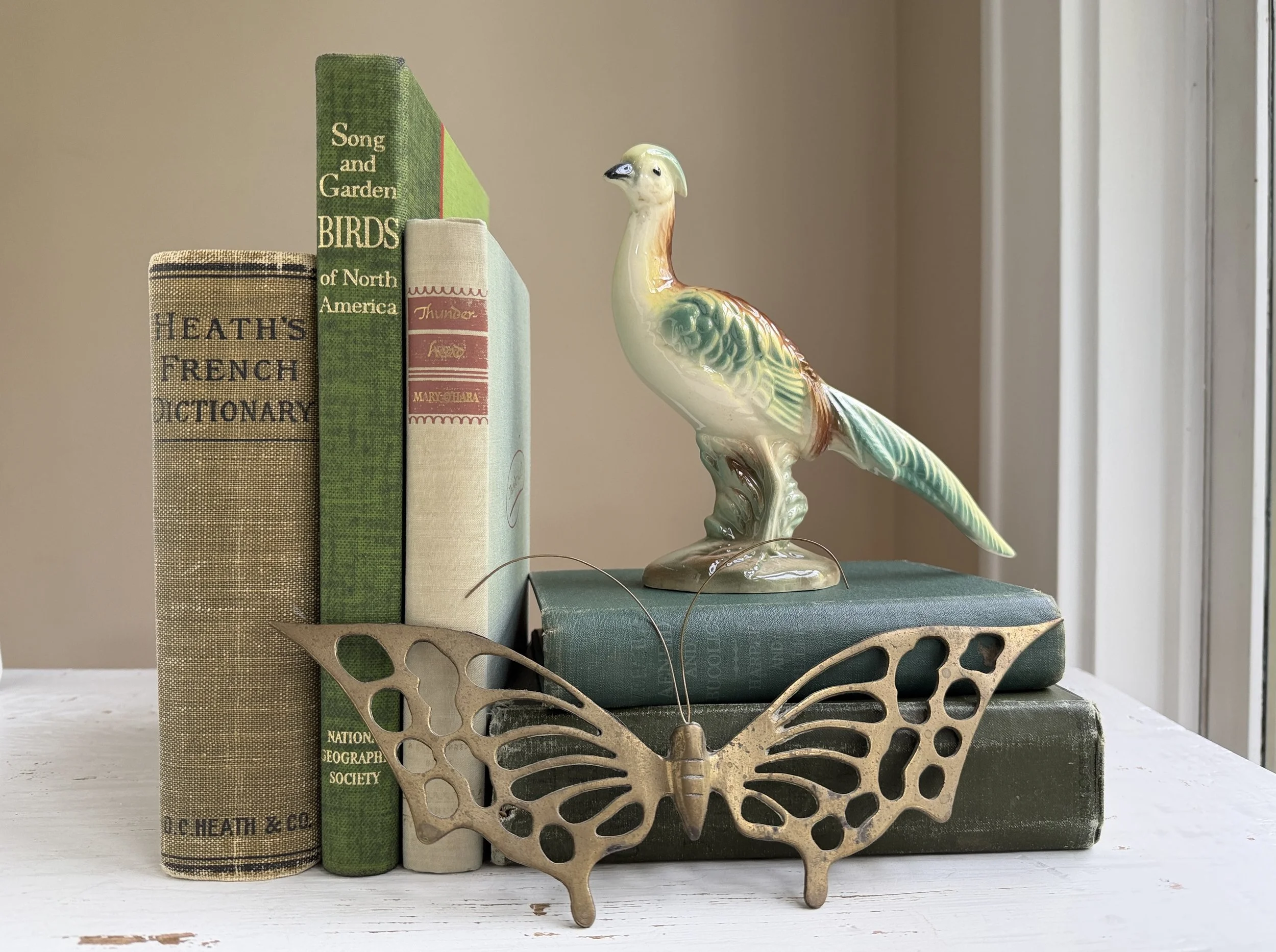
The muted greens of the vintage books find a "visual echo" in the ceramic bird’s plumage. By grouping these with a brass butterfly, I’ve tried to make this corner a focal point of meaning rather than collection of clutter.
For years, I felt a disconnect between loving antiques and loving simplicity. One side of me wanted to own and display all of the gorgeous “objects d’art” I could find. But I also loved a clean, organized space. Too much stuff made feel claustrophobic. It gave me anxiety. I liked tidy cleanliness, I liked purging old junk. But I didn’t like a sparse, open room. Empty walls and sharp edges felt cold and lonely to me. I needed a middle path.
The Art of Antique Minimalism
In reviewing the décor in my home, I realized the rooms that pleased me most had just enough. Antiques like my beloved rosemaling trays and ceramic birds warmed up a room while a blank area of wall visually calmed it down. There was a balance: a kind of minimalist approach to collecting, or what I think of as Antique Minimalism.
Antique Minimalism isn’t just owning one piece and you’re done. Because let’s face it, we antique lovers are never done. It’s the art of only displaying a certain amount of special pieces for a balanced room.
For instance, if you want your special objects to get the attention they deserve, don’t let your entire coffee table be jammed with books, candles, and knick-knacks down to the inch. Allow a quarter or third of the surface to be open for more visual calm. Similarly, a dining room wall loses its focal point when jammed with too many paintings, mirrors, and pictures. If you display a few beloved pieces, those pieces will be spotlighted even more. I believe in the end, less is more.
Choosing Your Essential Motif
Think of it this way: every object on display has to earn its place through character and harmony. Instead of a dozen scattered objects that pull the eye in different directions, create an Essential Motif. This might be a trio of vintage creamers in varying heights or pair of botanical prints leaning against a stack of linen-bound books.
When you’re curating these small islands of history, look for visual echoes. Perhaps the soft green of a Bavarian teacup is picked up in the hills of a landscape painting. By grouping fewer high-quality pieces together, you create a "moment" of intense beauty that feels substantial and gathered, rather than messy. This allows you to indulge your love for the find, the thrill of the Brocante, while maintaining the clean, open breathing room a sanctuary requires.
Bringing the Garden Inside
Because I love nature, I look for items that bridge the looseness of a garden with a structured room. A toleware tin or saucer with hand-painted roses doesn't just sit on a shelf. It brings the outside in and enhances my mental health through nature’s peaceful imagery.
The Benefits
Antique Minimalism allows you the quiet confidence of owning less, but ensuring what remains has a story deep enough to ground a room. A single porcelain plate with a sweet still life of flowers carries more visual and emotional weight than a dozen modern trinkets. When we stop filling our shelves with the disposable and the "temporary," we finally have the space, and budget, to welcome pieces that have already survived a century. By choosing quality over quantity, we aren't just cleaning our rooms; we’re curating a legacy.
Creating Your Sanctuary
If you’re wondering where to start, I invite you to try a "Thoughtful Edit" in one small corner of your home. Perhaps, it’s a bedside table, fireplace mantle, or favorite bookshelf.
Clear the surface completely. Wipe away the dust and let the space sit empty for a few minutes. Now, rather than reaching for what you’ve always had there, choose a few items that carry a true "patina"—pieces that feel storied, botanical, or deeply personal. Pieces that spark joy. Arrange them so they have space to breathe, ensuring that each object can be seen and appreciated from across the room.
But what if you like all of the objects you just removed? I have a solution. Choose objects that match best with the season. If it’s winter, choose the darker, heavier objects, or ones that give you a cozy, reassuring feeling. Contrarily, if it’s summer, try displaying the lighter colored or more delicate pieces. However you choose, know by seasonally rotating your things, you’ll be able to more easily appreciate your objects’ distinctiveness.
In other words, when you stop asking your surfaces to hold "everything," they begin to hold "meaning." That’s the heart of the Antique Minimalist life: an ongoing conversation between the objects we love and the space in which we need to feel at peace.
If you’d like to share Your Essential Motifs, I’d love to see them below.